
Have you ever watched the Moon rise above the horizon and noticed that it looks enormous compared with how it appears later in the night? This fascinating phenomenon has puzzled people for thousands of years.
The surprising truth is that the Moon does not suddenly grow larger when it approaches the horizon. Instead, the effect is known as the Moon illusion, a visual phenomenon connected to the way our brains interpret the world around us.
But why does it happen, and can you prove it yourself?
Does the Moon Actually Become Bigger?
No. The Moon does not physically increase in size as it rises above the horizon.
Its apparent size in the sky remains nearly the same during a single night. Photographs taken with the same camera settings can demonstrate this: the Moon’s horizontal width is almost identical when it is near the horizon and when it is higher in the sky.
So why does it sometimes look dramatically larger?
The answer lies in human perception. Our brains do not simply record what our eyes see. They also interpret distance, perspective and the surrounding environment to help us understand the world.
When the Moon appears close to buildings, trees, mountains or distant landscapes, our perception of its size can change.
Why Does the Moon Look So Huge When It Rises?
Scientists have studied the Moon illusion for centuries, but there is still no universally accepted explanation for every aspect of the phenomenon.
One leading explanation involves the way the brain estimates distance.
When we look toward the horizon, we often perceive the sky as extending far into the distance. The Moon near the horizon may therefore seem farther away than when it is high overhead. Because our brains associate distance with an object’s size, this can make the Moon appear larger.
Objects in the foreground, such as buildings and mountains, may also influence how we perceive the scene.
However, the illusion can occur even when there are no nearby objects to compare with the Moon. This suggests that the effect is more complicated than simply comparing the Moon with trees or buildings.
NASA explains that researchers continue to investigate the phenomenon, and there is not yet a definitive scientific explanation.
Does Earth’s Atmosphere Make the Moon Larger?
This is a common misconception.
Earth’s atmosphere does not magnify the Moon when it is close to the horizon. In fact, atmospheric refraction can make the Moon appear slightly flattened vertically when it is low in the sky.
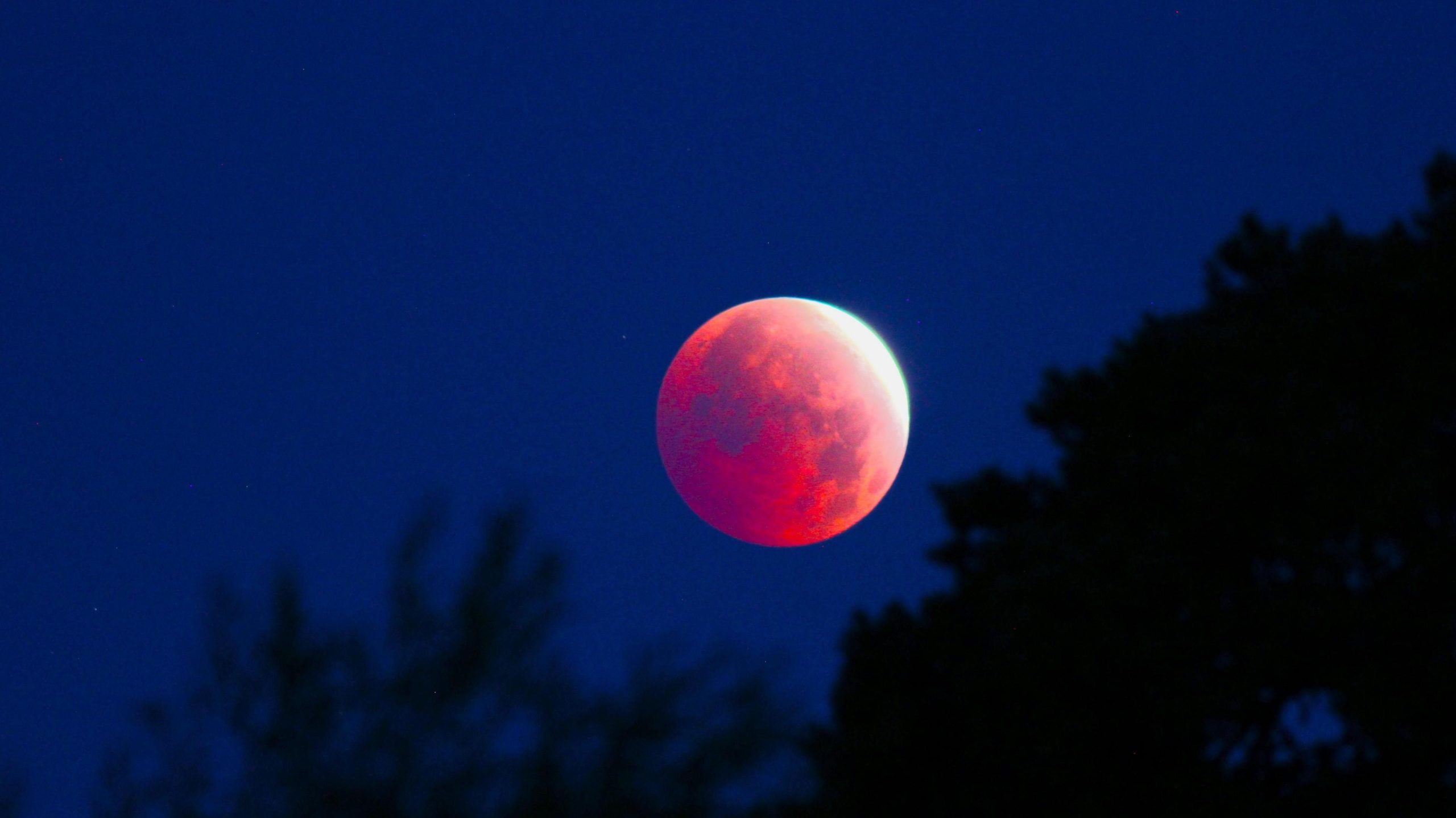
The atmosphere can also change its color.
When the Moon is near the horizon, its light passes through more of Earth’s atmosphere before reaching your eyes. Shorter blue wavelengths are scattered more strongly, allowing warmer yellow, orange or reddish colors to become more noticeable.
This is why a rising Moon can look orange without actually becoming larger.
Is the Moon Bigger During a Supermoon?
Sometimes the Moon really does appear slightly larger, but this is a different phenomenon.
The Moon follows an elliptical orbit around Earth, meaning its distance from our planet changes throughout the month. When a full Moon occurs near its closest orbital point, called perigee, it is commonly described as a supermoon.
A supermoon can appear somewhat larger and brighter than a typical full Moon.
However, the Moon illusion can happen during an ordinary full Moon, too. A Moon that looks gigantic near the horizon is not necessarily a supermoon.
The important difference is that a supermoon involves a real change in the Moon’s distance from Earth, while the Moon illusion is primarily a change in how we perceive its size.
How to Test the Moon Illusion Yourself
You do not need a telescope or expensive astronomy equipment to investigate this phenomenon.
Try this simple experiment the next time the Moon rises:
- Find a place where you can see the Moon near the horizon.
- Observe its apparent size and remember how large it looks.
- Wait until the Moon climbs higher into the sky.
- Compare its appearance with what you saw earlier.
- If possible, photograph it at both times using the same camera and zoom settings.
You can also look at the Moon through a small paper tube to reduce the surrounding visual information. This can help you notice how your perception changes when the landscape and horizon are no longer visible.
The Moon may seem much smaller as it climbs higher, even though its actual apparent diameter has barely changed.
Why Has the Moon Illusion Fascinated People for Centuries?
The Moon illusion is a remarkable example of how human perception can differ from physical reality.
People have described the phenomenon for thousands of years, and it continues to attract the attention of astronomers, psychologists and curious skywatchers.
It also demonstrates an important scientific principle: what we see is not always a perfect representation of what is physically happening.
The same Moon can look enormous above a distant mountain range and relatively small against the dark sky a few hours later. The difference is not necessarily in the object itself, but in how our brains interpret what we see.
Final Thoughts
The next time you see a giant-looking Moon rising above the horizon, take a moment to enjoy the view.
Although scientists have not settled every question about the Moon illusion, they know that the atmosphere does not simply magnify the Moon and that its apparent size remains nearly constant during a single night.
Sometimes, one of the most fascinating sights in astronomy is not a distant galaxy or a powerful telescope image, but something familiar that makes us question our own eyes.
The Moon has not grown larger. Your perception of it has changed.
Leave a Reply