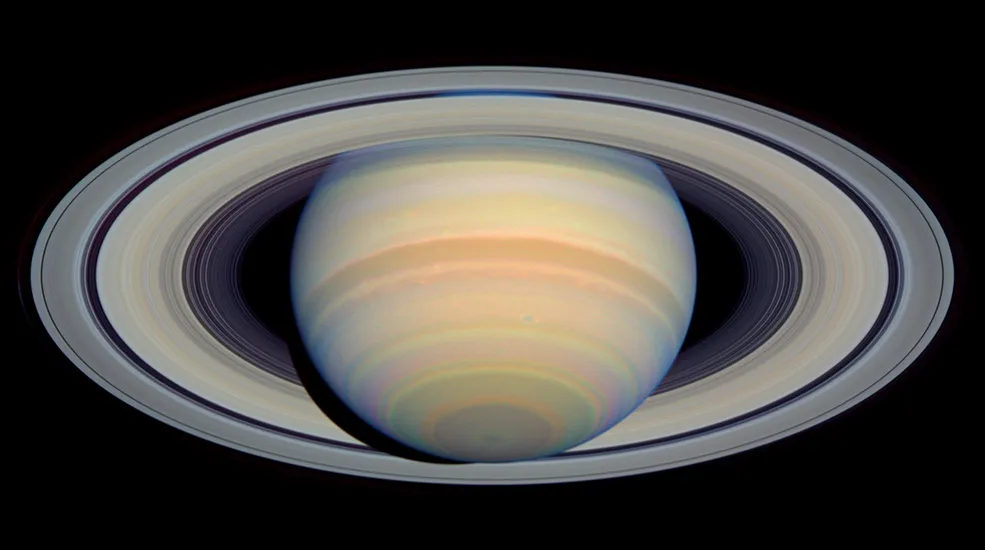

Saturn is one of the most fascinating planets in our Solar System. Famous for its spectacular rings, enormous size, and mysterious moons, this distant gas giant has captured the attention of astronomers for centuries. But beyond its beautiful appearance lies a world of extreme weather, powerful winds, and extraordinary scientific discoveries.
Located approximately 1.4 billion kilometers from the Sun, Saturn remains one of the most intriguing destinations for planetary science.
What Is Saturn?
Saturn is the sixth planet from the Sun and the second-largest planet in our Solar System, after Jupiter. It is classified as a gas giant, meaning it is composed primarily of hydrogen and helium.
With an equatorial diameter of approximately 120,500 kilometers, Saturn is nearly nine times wider than Earth.
Unlike our planet, Saturn does not have a solid surface. Its atmosphere gradually becomes denser under enormous pressure, eventually transitioning into layers of liquid hydrogen and other materials.
One of Saturn’s most surprising characteristics is its low average density. In fact, it is the only planet in our Solar System with an average density lower than water.
The Spectacular Rings of Saturn
Saturn’s rings are among the most recognizable structures in astronomy. Although other giant planets also have rings, Saturn’s system is by far the most visually impressive.
These rings are not solid structures. Instead, they consist of countless individual particles made primarily of water ice, mixed with rocky material and dust.
The particles range in size from tiny grains to enormous chunks several meters across.
Saturn’s main ring system extends approximately 282,000 kilometers from the planet, yet its main rings are surprisingly thin, typically around 10 meters in vertical thickness.
Scientists believe the rings may have formed from comets, asteroids, or moons that were destroyed by Saturn’s gravitational forces.
Despite their enormous appearance, the rings remain one of the biggest mysteries surrounding the planet.
A World With Hundreds of Moons
Saturn is not just a planet with beautiful rings. It is also surrounded by an extraordinary collection of natural satellites.
NASA reported 274 confirmed moons orbiting Saturn as of March 2025, making it the planet with the most confirmed moons in our Solar System at that time.
Among them, two stand out:
Titan is Saturn’s largest moon and is even bigger than the planet Mercury. It has a thick atmosphere dominated by nitrogen, along with lakes, rivers, and seas filled with liquid methane and ethane.
Enceladus is a small icy moon that has attracted enormous scientific interest. Beneath its frozen surface lies a global ocean of liquid water. It also releases powerful jets of water vapor and icy particles into space.
These discoveries have raised an important scientific question: Could some of Saturn’s moons provide environments suitable for life?
Although no life has been discovered, Titan and Enceladus remain important targets in the search for potentially habitable worlds beyond Earth.
Extreme Weather and the Mysterious Hexagon
Saturn experiences some of the most extreme weather conditions in the Solar System.
Winds in its upper atmosphere can reach approximately 1,800 kilometers per hour, significantly faster than the strongest winds recorded on Earth.
One of its most extraordinary atmospheric features is a massive hexagon-shaped jet stream surrounding the north pole.
This unusual structure stretches approximately 30,000 kilometers across and contains a powerful rotating storm at its center.
Scientists first noticed the hexagonal pattern in images captured by the Voyager spacecraft during the early 1980s. Later observations by NASA’s Cassini spacecraft revealed much more detail about this unusual phenomenon.
Saturn’s atmosphere also experiences enormous storms, changing cloud patterns, and complex seasonal variations.
How Long Is a Day on Saturn?
Time passes differently on Saturn.
A complete rotation takes approximately 10.7 Earth hours, making its day much shorter than ours.
However, its journey around the Sun is considerably longer. Saturn takes approximately 29.4 Earth years to complete one orbit.
This means that someone living on Saturn would experience a year lasting almost three decades on Earth.
Saturn also has seasons because its rotational axis is tilted by approximately 26.7 degrees, similar to Earth’s axial tilt.
The Cassini Mission: Exploring Saturn Up Close
Our understanding of Saturn changed dramatically with NASA’s Cassini mission.
Launched in 1997, the Cassini spacecraft arrived at Saturn in 2004 and spent 13 years studying the planet, its rings, and its moons.
During its mission, Cassini made remarkable discoveries, including evidence of a global ocean beneath Enceladus’ icy crust and the existence of liquid hydrocarbon lakes on Titan.
In September 2017, the spacecraft ended its historic journey by entering Saturn’s atmosphere, where it was destroyed.
Its observations continue to provide scientists with valuable information about the Saturnian system.
Why Is Saturn Important to Astronomy?
Saturn is much more than a beautiful planet with impressive rings.
Its complex atmosphere, unusual magnetic environment, and fascinating moons offer scientists an opportunity to understand how planetary systems develop and evolve.
Its moons, especially Titan and Enceladus, may also help researchers understand where conditions suitable for life could exist beyond Earth.
Even after decades of exploration, Saturn continues to reveal new scientific mysteries.
Final Thoughts
Saturn remains one of the greatest wonders of our Solar System. From its enormous ring system to its mysterious icy moons, almost every part of this distant planet offers something extraordinary to discover.
As technology advances and future space missions explore the outer Solar System, scientists may uncover even more secrets hidden within Saturn and its fascinating collection of moons.
The ringed giant is a reminder that our Solar System still holds countless mysteries waiting to be explored.
Leave a Reply